Stair Flooring in OKC: Carpet, Luxury Vinyl or Wood on Your Staircase?
· 7 min read · By Floors To You OKC
Most flooring decisions are made room by room, and the staircase gets decided last, almost as an afterthought: whatever goes on the floor above or below. That is how a lot of stairs end up slippery, loud, or worn through at the nose within a few years. A staircase is its own job with its own rules, and it is worth choosing on purpose. Here is how the three common options actually behave on stairs in an Oklahoma City home.
Why stairs are a different decision
Three things make a staircase unlike any other floor. All the wear lands on a few inches of each step, the front edge or nose, where every foot pivots on the way down. Safety matters more here than anywhere else in the house, because a slip on a stair is a fall, not a stumble. And the installation is not rolled out or clicked across a room. Every tread and every riser is cut, fitted and fastened individually.
That last point is why stairs are always priced per step rather than per square foot, whichever material you choose. Our guide to what carpet installation costs in OKC explains why a fourteen-step staircase is a genuine half day of skilled work.
Carpet on stairs: still the most forgiving choice
Carpet remains the most common stair surface in the metro for good reasons. It is the most slip-resistant option, especially for kids, older family members and dogs. It is the quietest, which matters when the stairs sit next to a bedroom or open onto the living room. And it is usually the least expensive per step.
The fiber matters more on stairs than in any bedroom. Nylon springs back from the constant pivot at the nose better than polyester, so it holds its look longer on a busy staircase. Be careful with loose loop Berber if you have pets, because a claw can catch a loop and pull a run. Pad matters too: a dense pad wrapped over the nose protects the carpet at exactly the point it wears first.
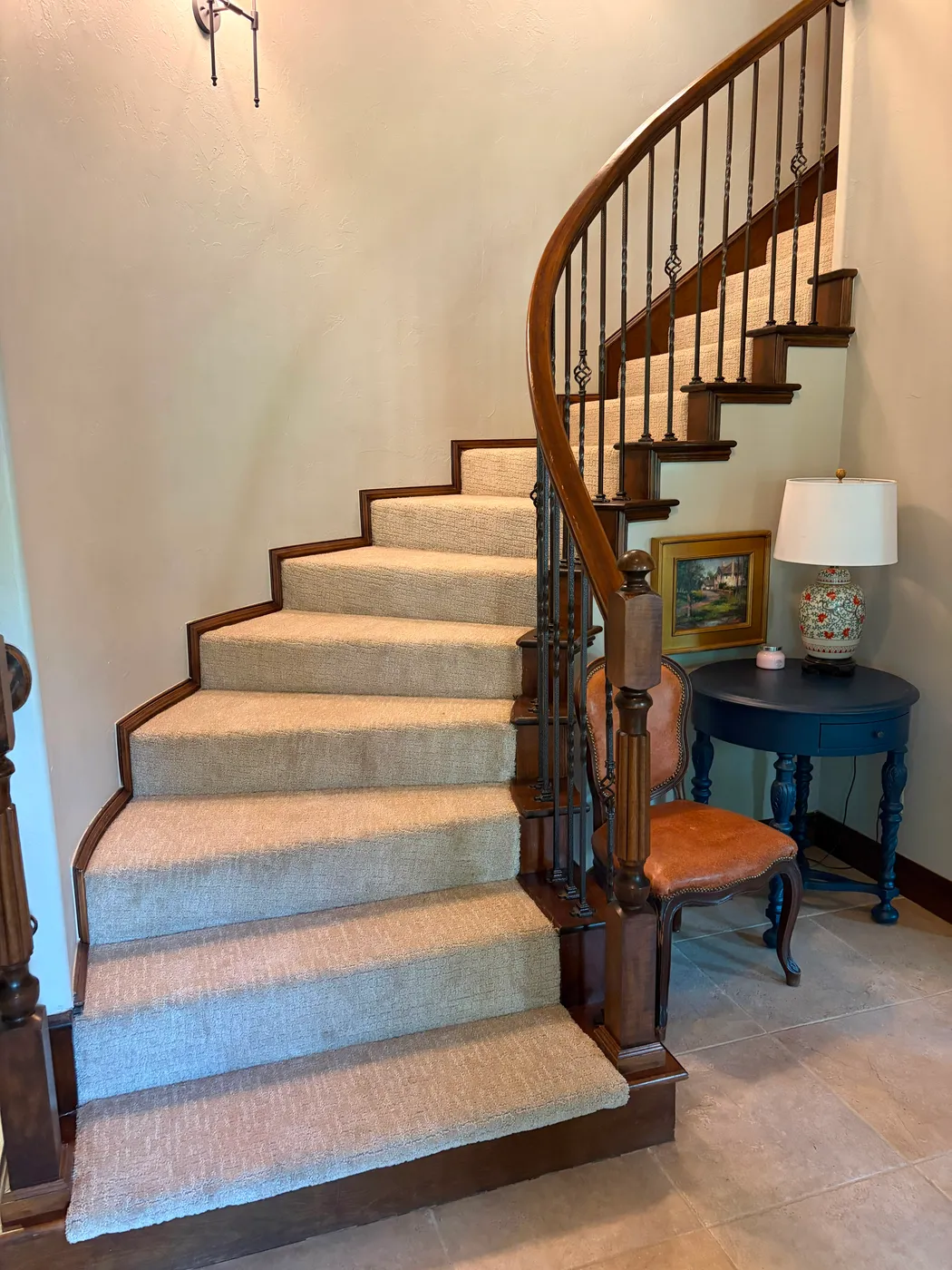
Then there is the wrap style. Waterfall, where the carpet drops straight from the nose to the tread below, is faster and costs less. Cap-and-band, where the carpet is tucked under the nose and follows the shape of the step, looks tailored and costs more. Our carpet buying guide covers fiber and style in more depth.
Luxury vinyl on stairs: waterproof and matching, with more labor
When the main floor is going to waterproof luxury vinyl plank, many homeowners want the stairs to match so the flooring flows from one level to the next. It can be done, and done well, but it is a different installation from the floor itself.
A click-lock plank cannot float on a staircase the way it floats across a room. Each tread and riser is cut from plank, glued down, and finished with a stair nose piece made to match the product, which is fastened so it cannot shift under a heel. That is more labor per step than carpet, and it is worth confirming that a matching stair nose exists for the plank you like before you commit to it for the whole house.
On traction, look for a plank with a textured or embossed surface rather than a smooth, glossy one, and think honestly about who uses the stairs in socks. Our guide to click-lock versus glue-down LVP explains the two installation methods on the flat floor.
- ✓Treads and risers glued, not floated
- ✓A matching stair nose, fastened, on every step
- ✓A textured surface for grip
Wood stairs: the classic look, and the most finish work
Hardwood and engineered wood treads give a staircase the most architectural look, and they suit homes where the main floor is wood. They are also the hardest-wearing surface at the nose when the finish is looked after, and the finish can be renewed rather than the stairs replaced.
The tradeoffs are sound and slip. Wood stairs are louder, and a finished wood tread in socks is the least forgiving surface of the three. Many families solve both with a carpet runner down the center, which keeps the look of the wood at the edges and puts grip and quiet where people actually walk. Our hardwood care guide covers how to keep the finish healthy through Oklahoma's humidity swings.
Getting the top and bottom of the stairs right
The places people notice are where the staircase meets the floors around it. The top step should finish in a nose that matches the landing, not an awkward reducer. The bottom step should meet the lower floor cleanly, with no lip to catch a toe. And the height of the new flooring has to be accounted for, because adding thickness to the landing and the lower floor changes the height of the first and last step compared with the rest.
If the stairs will match a hard floor elsewhere in the house, buy the material for both at the same time. Flooring is made in batches that vary slightly in color, and a staircase done a year after the main floor can visibly miss. Our guide to in-stock versus special-order flooring explains dye lots and how to avoid a mismatch.
Which one fits your household
There is no universally right answer, but the household usually makes the decision obvious.
- ✓Young kids, older family members or dogs on the stairs → carpet, or wood with a runner
- ✓Stairs beside a bedroom or open to the living room → carpet for quiet
- ✓Waterproof LVP on the main floor and you want one continuous look → LVP with matching stair nose
- ✓Wood main floor and a statement staircase → hardwood or engineered wood treads
- ✓Tightest budget → carpet, and put the savings into a good nylon and a dense pad
Seeing it on your own stairs
Stairs are hard to picture from a sample board, because the light on a staircase is usually nothing like the light in a showroom. We bring samples to your home, hold them against your actual treads and railings, count and measure the steps, and look at how the stairs meet the floors at the top and bottom. You get a per-step price in the same visit. Book a free in-home estimate and we will walk the staircase with you.